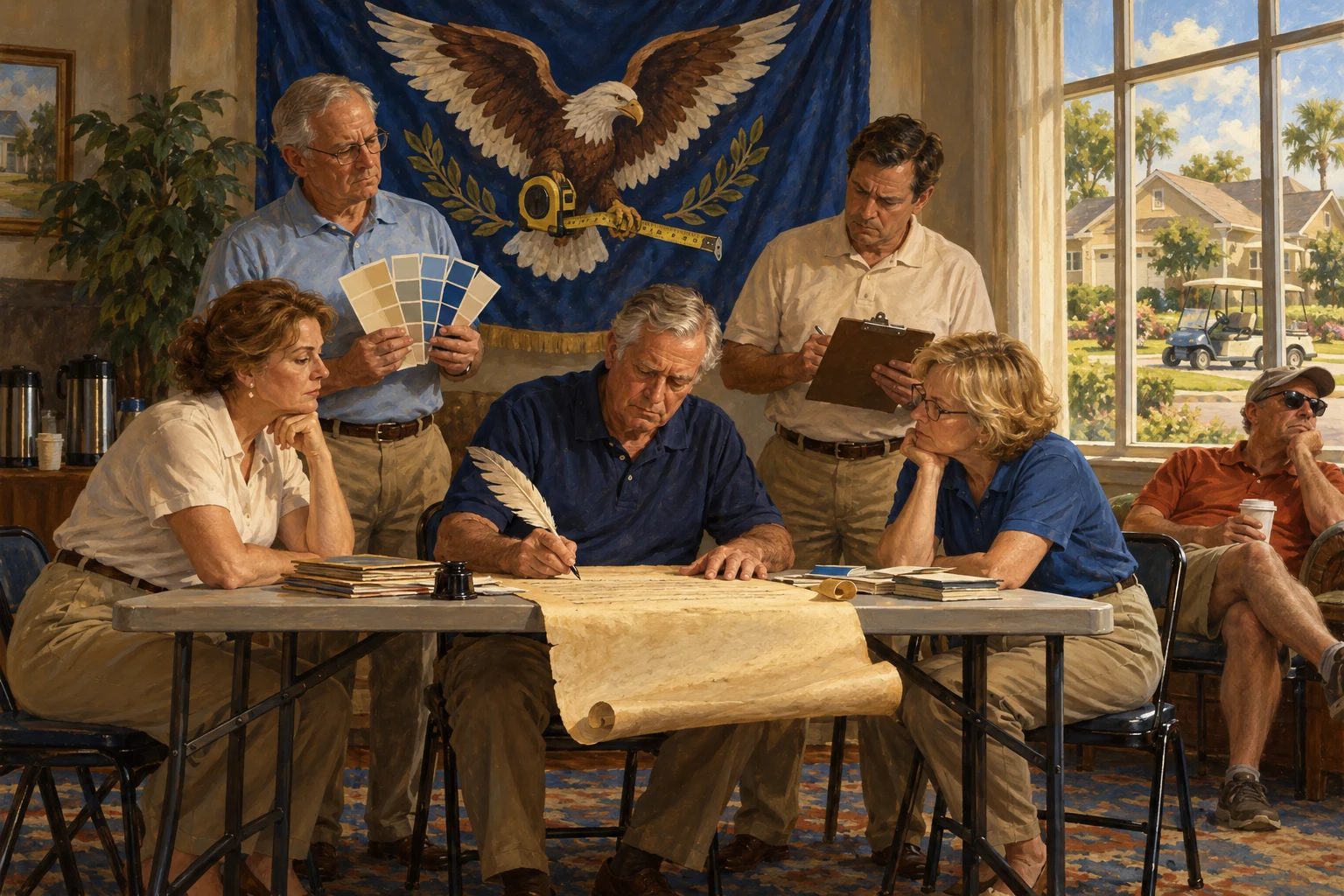
You come home from work to discover that your HOA has declared independence from the United States.
There's a flag at the entrance, a border checkpoint beside the speed bump, and an email explaining that your monthly dues are now taxes. They're still due on the first.
Honestly, if anyone was going to try this, it was probably the people who already believe they have final authority over your mailbox.
But declaring independence is the easy part. You can declare just about anything. Getting the United States to agree that your cul-de-sac is no longer its problem would take considerably more work.
So, what would actually need to happen?
First, the neighborhood would need a reason to leave
A disagreement about trash pickup probably wouldn't convince an entire neighborhood to abandon its country. Most people would prefer to call the city, complain for a while, and continue being American.
We'd need something bigger.
Suppose a developer builds an enormous private community outside a growing city. Over the next several decades, neighboring developments join it. Eventually, what started as an HOA covers a substantial area, with thousands of residents and businesses inside its boundaries.
For our scenario, the association owns and maintains its roads, pays for private security, and arranges much of its own infrastructure. The surrounding government still has authority, but residents begin asking what they're getting for the taxes they pay on top of their association dues.
Then comes a long dispute over services and a new tax increase. The community wants more control. Its board wants much more control.
Naturally, the board expresses this through a strongly worded email.
This alone wouldn't create a country. But it could give the residents a shared grievance and an organization capable of turning that grievance into a political campaign.
Without that support, the HOA president is just a man announcing foreign policy in a room where everyone else came to discuss mulch.
It would need enough money to survive the idea
Independence becomes less attractive when someone asks who will pay for the sewer system.
Our aspiring country would need businesses, jobs, and a reliable source of revenue. It would also need arrangements for things the association has never handled before, including emergency services and courts.
A pool maintenance budget would not quite cover it.
So let's give this community an unusually successful industry. Perhaps a company inside it develops a manufacturing process that becomes enormously valuable. Other companies move in. The neighborhood grows into a wealthy business district with houses attached.
Now the independence movement has employers who can fund it and residents who think it might work.
The board's financial presentation suddenly looks much better, although there's still an alarming line item labeled “presidential residence.”
Even this wouldn't make the community self-sufficient. It would probably depend on surrounding territory for electricity, food, or access to roads. Those dependencies would have to become agreements with its neighbor rather than things everyone assumes will keep working.
Your new country could survive without its own power plant. It would struggle if its entire foreign policy consisted of insulting the people who supply its power.
The United States would have to accept an extraordinary political deal
Here's the part where the idea runs into something substantially more powerful than an HOA.
The United States.
Buying land doesn't buy sovereignty. Owning roads doesn't remove them from the country. And changing the association's name to the Republic of Pleasant Meadows doesn't make federal law stop at the entrance sign.
In Texas v. White, the Supreme Court rejected unilateral state secession. An HOA is not a state, and that decision doesn't supply a neighborhood-sized escape clause.
For this scenario, we would have to imagine a major change in the country's political and constitutional arrangements, followed by an agreed settlement that actually allowed this territory to leave. There isn't an existing HOA form for that.
Not even one you can pay extra to have processed faster.
Why would the United States consider such an arrangement? Under ordinary circumstances, it probably wouldn't. We'd need a much larger political upheaval in which negotiating new territorial arrangements had become a serious national question.
Perhaps a prolonged crisis produces a broad agreement to reorganize the country. Our unusually wealthy, organized community then manages to get its own independence proposal included in those negotiations.
That is an enormous assumption. It's also the assumption doing most of the work here. Without it, we've explained how an HOA could become an expensive local government, not an independent country.
Doug cannot get around this by quoting the bylaws more loudly.
Residents would have to agree on what independence means
Let's generously assume that the national negotiations don't immediately reject the proposal.
The community would still need an agreement its residents could live with. They would have to settle who governs, which land is included, and what happens to people who don't want to join the new country.
They would also need answers about property rights, citizenship, and existing obligations. A mortgage doesn't disappear because someone raises a new flag over the clubhouse.
Otherwise, this wouldn't be a political settlement. It would be an HOA board discovering a spectacular new way to get sued.
The residents might demand elections, limits on the board's power, and protections for their rights. Some might even insist that a government shouldn't be able to punish them for the wrong shade of blue.
At this point, Doug begins to wonder whether independence was such a good idea after all.
Nevertheless, the movement continues. It establishes a government that can run the territory and honor the agreements that made separation possible.
The secretary gets a new title. The minutes remain overdue.
The borders would need to work in both directions
A sovereign neighborhood surrounded by the United States would have a fairly important relationship to maintain.
Residents would still want to travel. Businesses would still want deliveries. Anyone who works outside the territory would need to get to their job without treating every Monday morning as an international expedition.
The settlement would therefore need practical arrangements for access, trade, and services. Whether there were border checks would depend on those arrangements, not on how enthusiastic Linda was about her new security uniform.
The community could keep using dollars. Printing a currency isn't a prerequisite for independence, and introducing MeadowBucks would create another problem for a government already struggling to set up its first customs office.
Besides, the plumber would prefer dollars.
Security would also need a serious agreement. A neighborhood watch and two golf carts would not make the new country capable of defending itself. A peaceful arrangement with the surrounding United States would be far more useful than naming Gary commander of the armed forces.
Especially since Gary keeps forgetting to charge the golf cart.
Other countries would have to take it seriously
Even with an agreed separation, the new government would want other countries to recognize it and establish relations.
Recognition would involve diplomatic decisions by those countries. It wouldn't arrive automatically with the new stationery.
And the United Nations wouldn't simply stamp the HOA's application. Admission requires a Security Council recommendation and a General Assembly decision. UN membership is separate from getting individual countries to recognize you.
Our neighborhood would therefore need a convincing settlement, a functioning government, and diplomats who can discuss something other than property values.
The board might offer a spare building as an embassy. Unfortunately, the architectural committee would still have questions about the proposed flagpole.
So, could your HOA actually become a country?
You'd need a community that grew into a substantial territory, an economy capable of supporting it, and residents willing to accept the consequences. Then you'd need an extraordinary national political settlement that allowed it to leave, workable agreements with the United States, and functioning relations abroad.
Each step depends on the ones before it. A wealthy community with no agreed separation remains a wealthy community. A declaration with no functioning government remains a declaration.
The scenario requires so many unusual developments that I wouldn't start applying for a neighborhood passport. But the absurdity comes from stretching recognizable institutions and political decisions, rather than finding a magic sentence in the HOA handbook.
And should all of it somehow happen, you'd finally be free from the United States government.
Your trash can would still need to be out of sight by 6 p.m.
Satire note: this is an exaggerated hypothetical, not a prediction or a legal route to independence. Pleasant Meadows and its board members are fictional. The linked sources support the specific factual points beside them, not the imagined chain of events.